Mineral-rich by design.
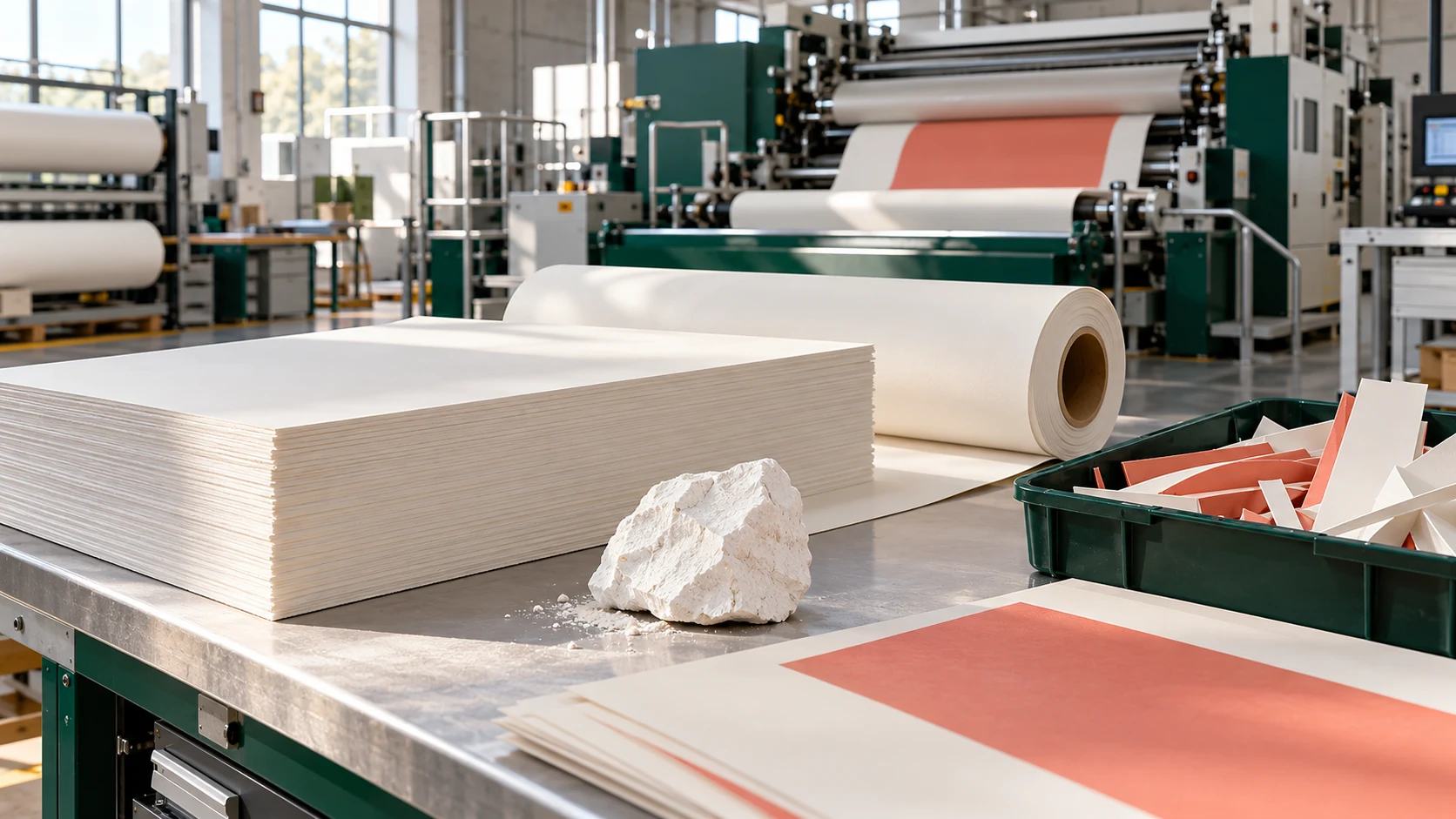
Calcium carbonate forms the largest share of the base material. Non-toxic HDPE resin provides cohesion and structure, with a lower non-toxic HDPE resin share than conventional polymer-led print films.


SUSTAINABILITY
A production story built around material choice, tree-free composition and practical recovery routes.
RETHINKING THE MATERIAL FOUNDATION
CAMIPRI brings a mineral-rich alternative to selected applications served by PP, BOPP, PE, PET and PVC print substrates. Its tree-free composition also makes it an option for selected wood-pulp-based print applications.
From menus and tags to labels, packaging and visual communication, the starting point is a useful printed product. Our material combines calcium carbonate and non-toxic HDPE resin, with a premium paper-like feel.
OUR MATERIAL FOUNDATION
Calcium carbonate forms the largest share of the base material. Non-toxic HDPE resin provides the structure that turns the mineral into a printable sheet or roll.
Calcium carbonate forms the largest share of the base material. Non-toxic HDPE resin provides cohesion and structure, with a lower non-toxic HDPE resin share than conventional polymer-led print films.
No bleaching agents are used in the production of our mineral-based substrate. Its warm-white appearance is part of the material’s character.
The base-material forming process consumes no process water. Water circulates for cooling. This avoids the wet-pulping and water-based sheet-forming stages used for wood-pulp paper.
The process-water statement covers base-material forming. Raw-material production and other supply-chain stages still have water requirements.
A CLEAR COMPOSITION STORY
A mineral foundation without wood pulp or PVC in the base substrate.
The mineral base contains no chlorine or plasticisers. Its structure comes from calcium carbonate combined with non-toxic HDPE resin, rather than a wood-fibre network.
Our mineral-based, tree-free substrate contains no wood or wood pulp and is outside the scope of EUDR. Paper liners, wood-based packaging and other added components are assessed separately.
Understand the EUDR scope →MATERIAL & PRODUCTION COMPARISON
A practical comparison of the base materials behind mineral substrates, synthetic print media and wood-pulp paper. These are characteristic production routes, not a ranking of total environmental impact.
| What matters | CAMIPRI | Synthetic print media PP · BOPP · PE · PET · PVC | Wood-pulp paper Including coated art paper |
|---|---|---|---|
| Material foundation | 60–80% calcium carbonate with 20–40% non-toxic HDPE resin by mass. | Polymer-led: PP, BOPP, PE, PET or PVC; fillers and surface treatments may be added. | A fibre network made from wood pulp; coated art papers also use mineral fillers and binders. |
| Role of wood pulp | No wood pulp in the base substrate. | No wood pulp in the base film. | Wood pulp provides the structural fibre network. |
| How the substrate is formed | Mineral and non-toxic HDPE resin are compounded and formed into sheets or roll media. | Polymer is formed into film; some films are stretched or laminated. | Fibres are dispersed in water, formed into a web, pressed and dried. |
| Process water | No process water consumed in base-material forming; cooling water circulates. | No wet-pulping stage. Cooling and other process-water needs depend on the manufacturing route. | Water is integral to pulping and sheet formation; mills recover and recirculate part of it. |
| Bleaching | No bleaching agents used in producing our mineral substrate. | No wood-pulp bleaching stage in base-film production. | Bleached pulp may be used for white papers; unbleached and recycled alternatives also exist. |
| Material feel | Premium paper-like, warm white, with opacity and stiffness selected through the density series. | A film-based surface; options range from flexible films to stiff synthetic sheets. | A familiar fibrous paper surface, available in coated and uncoated finishes. |
| Moisture and handling | Water-repellent, durable base material for frequently handled print. | Typically resistant to water; performance depends on the finished construction. | Untreated fibre paper absorbs moisture; coatings, wet-strength treatments or lamination can improve resistance. |
| Production offcuts | Clean, separated material can be reprocessed into new mineral-based material through a suitable route. | Clean, sorted offcuts can be reprocessed where a route exists for the polymer. | Suitable fibre offcuts can be repulped through paper-recycling systems. |
| After use | Arrange collection and acceptance with a suitable local reprocessor. | Collection and acceptance depend on polymer type, additives and construction. | Collection and acceptance depend on coatings, contamination and construction. |
Compare the same finished application when assessing total environmental impact. Energy, transport, print yield and end of life also matter; this table does not establish a lower carbon or water footprint per printed piece.
KEEP MATERIAL IN USE
Separate it. Collect it.
Confirm the reprocessing route.
Keep unused sheets and production trimmings separate from mixed print waste, liners and other materials.
Clean, compatible material can be milled and returned to a suitable mineral-filled non-toxic HDPE resin processing stream.
Recovered production material can become feedstock for new CAMIPRI material, subject to the required formulation and quality controls.
Collection and reprocessing depend on the local waste operator. Confirm acceptance and the route before disposal.
BASE-MATERIAL COMPOSITION
The foundation of the base substrate.
Cohesion and flexibility.
Component ranges by mass. A lower non-toxic HDPE resin proportion is a composition difference; it is not the same as a measured reduction in environmental impact.
MAKE THE MATERIAL CHOICE TANGIBLE
LET’S PUT IT TO THE TEST
Tell us what you want to produce. We will help you select the right material.
Request a production trialProduct finder